
Trauma-Aware Care in Aged Care: Why Listening Matters

As Used & Trusted


Trauma-Aware Care in Aged Care Starts with Listening
A resident turns her face to the wall when the worker walks in with a towel. The worker has a schedule, and the care plan says a shower is due. The quick conclusion is refusal. Another explanation is that she's telling you something.
Maybe it's about being touched without warning. Maybe the bathroom feels like somewhere she once wasn't safe. You may never find out which. You can still change what you do next.
That's where trauma-aware and healing-informed care starts: curiosity before assumption. It doesn't mean every behaviour is a response to trauma. It means asking what a person might be communicating before deciding how to manage it.
What the Strengthened Aged Care Quality Standards require
Trauma-aware care sits inside the Strengthened Aged Care Quality Standards, so it belongs in your quality system as well as your training calendar.
Outcome 1.1 requires providers to understand and value each person's identity, culture, diversity, beliefs and life experiences, and to tailor care to their needs, goals and preferences. It names care that is trauma aware and healing informed.
Outcome 3.2 requires funded aged care services to be culturally safe, trauma aware and healing informed, based on contemporary, evidence-based practice.
The Aged Care Quality and Safety Commission recognises that older people may have experienced abuse, assault, serious accidents, war, natural disasters, loss and institutionalisation. For older Aboriginal and Torres Strait Islander people, that includes the impacts of colonisation, dispossession, systemic discrimination and intergenerational trauma.
Focus on what makes people feel comfortable, and what doesn't
Your care should focus on what makes each person feel comfortable and what doesn't. That's the information that shapes how someone experiences a shower, a meal, a new face at the door or a change in routine.
Resident history notes are the place to keep it. Record what helps a person feel safe, what unsettles them and how they like things done. Many histories will never be fully known, and people share in their own time, if at all. You don't need to ask anyone to disclose painful experiences. You need to notice, write it down, and make sure the next worker doesn't start from zero.
Small moments that build trust
Ask, "Is it okay if I help you with this?" Explain what you're about to do before you do it. Offer a choice. Allow more time. Approach calmly. Step back when someone needs space.
Each of these is small. Together they decide whether care feels predictable and respectful to the person receiving it.
Have you asked your staff how confident they feel?
Most providers can say how many staff completed trauma-aware care training. Fewer can say how many feel ready to use it when a resident becomes distressed at 6am and the call bells are going.
A completion record shows who attended. It doesn't show who's confident. If the Standards expect this care to be part of everyday practice, confidence is worth measuring directly.
Ask your staff, and ask in a way that makes honest answers safe:
• How confident are you responding when a resident refuses personal care or becomes distressed?
• What would help you feel more confident?
• When did you last see a colleague handle a hard moment well?
Keep it anonymous and short. Then do the part that matters most: read the answers, share what you heard and act on it. Staff who see their feedback change something will tell you more next time.
Hear it from the people providing care
There is a lot to learn from frameworks, policies and formal training. There is also something powerful about hearing how these ideas play out in real care.
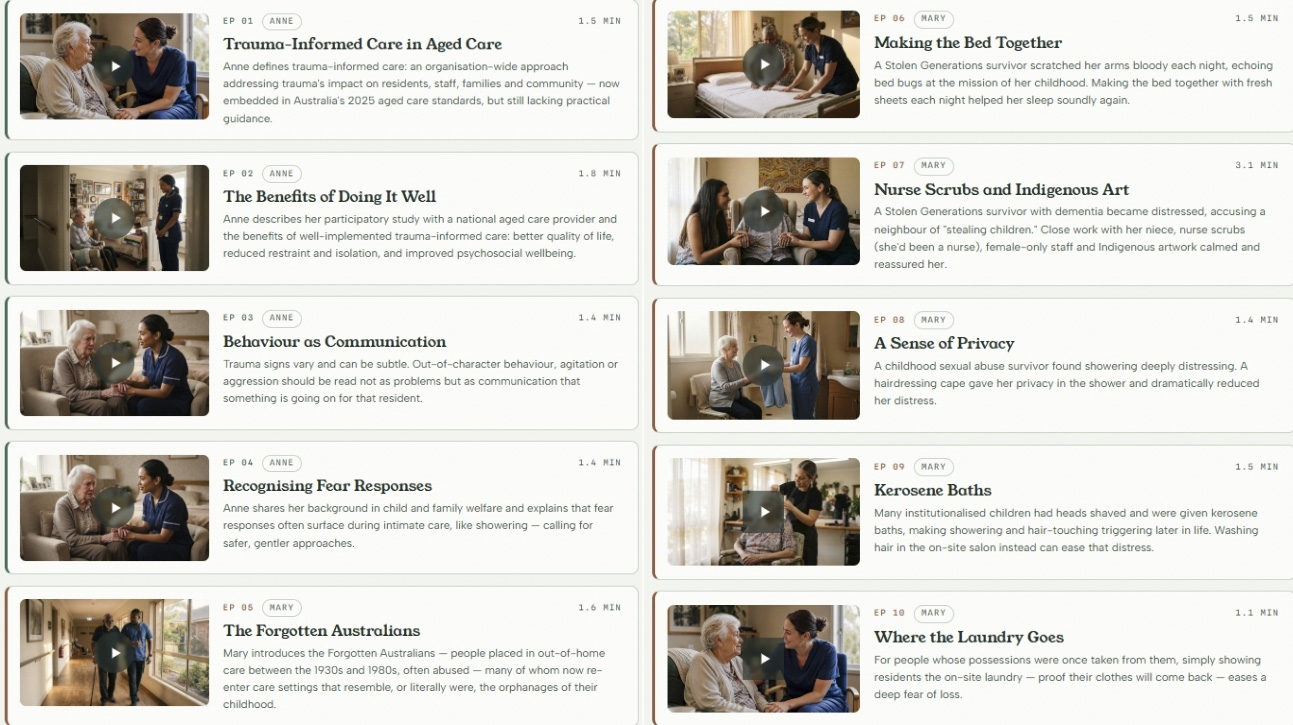
Our Trauma-Aware & Healing-Informed Care podcast series has 30 short episodes: 24 stories from people working in aged care, and 6 educational episodes on practical capability. Each one is short enough to fit into a shift.
Play this episode at your next team huddle and ask the same question: how confident do we feel doing this?
We've built a library of 30 short episodes with care workers, drawn from their own experience of trauma-aware and healing-informed care.
Published by Forget Me Not®, a microlearning and spaced repetition platform for aged care.
Blog Related


The 5-Minute Mentor: Evidence-based Learning Insights
Transform your team with monthly microlearning insights you can implement immediately.
